
Owners make hundreds of decisions every week — and too many stall because the information sits scattered across platforms, spreadsheets, and conversations. The challenge isn't collecting information; it's turning it into decisions. Bridge does that in a few minutes, a couple of times a day: everything captured on the floor rolls up here as a decision, not a data dump.
Out front with customers and staff, holding the business together — while Bridge holds the numbers.
What happened, what needs a human call, and what's already handled and doesn't need attention — four kinds of decisions, each sourced from something Compass recorded on the floor.
Revenue, margin, and payroll cost — the day's headline numbers, read in about fifteen seconds. No spreadsheet, no export — just the three figures that actually run the business, already there when the owner glances over.
Two flags this morning: overtime creeping on Thursday, a quality note from the floor. Both handled before coffee — because they surfaced on their own instead of waiting to be found.
Three things worth this owner's attention today, ranked — not buried in a list of forty. The one that matters most sits at the top, every time, so the day starts on the right call.
The week rolled into one page instead of six exports and a Sunday night. Fifteen minutes on Friday tells the owner what actually happened — and what to change before Monday.
A schedule swap and a vendor invoice, both waiting on a yes. One tap each, then back to the floor — the decision made by a person, not deferred to a form.
What got decided, when, and why — a running record instead of a memory to reconstruct later. Next quarter starts from here, not from zero.
Bridge is deliberately not a workspace — it's a cockpit. The owner glances, approves what needs approving, and gets back to running the shop instead of running the reports.
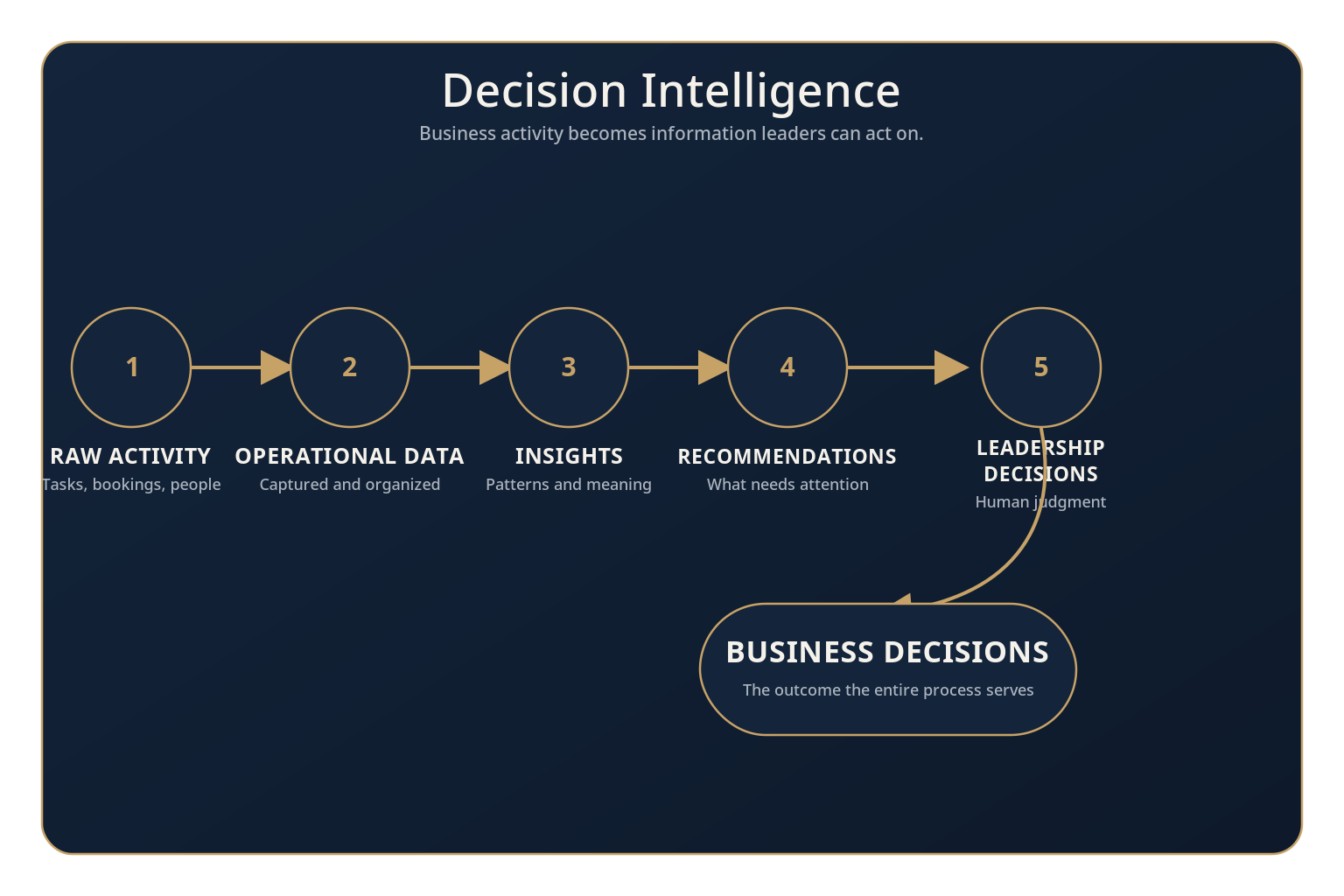
Everything Compass captured on the floor — staffing, workload, service quality, the customer and pet record — rolls up here as a decision, not a data dump: what happened, what needs a human call, and what's already handled and doesn't need attention.
Bridge doesn't invent numbers — it surfaces the ones Compass already captured, framed as something an owner needs to act on.
What the day or week actually earned, against what it cost to deliver — so pricing and yield decisions are made on real numbers instead of gut feel.
Payroll against the work actually on the books, so idle hours, overtime creep, and staffing mismatches surface before they quietly eat the margin.
The pattern behind the individual visit: is the standard holding, where's it slipping, and which flags from the floor need a policy answer instead of a one-off fix.
The people-side signal — a groomer running consistently behind, a bottleneck at one station, a note that needs a human follow-up — escalated up instead of buried in a day's notes.
Compass powers the operation. Bridge informs leadership. People make the decisions.
The two numbers the whole business runs on — payroll cost and margin — are the headline of what Bridge shows, and both are only visible because Compass was capturing the underlying reality all day, every day, on the floor.
A staffing change, a pricing adjustment, a new service standard — whatever the owner decides in Bridge doesn't stay in Bridge. It changes how the next round of bookings gets handled and how Compass itself gets configured, closing the loop and starting the cycle again, a little smarter than the last one.
Bring your shop, and we'll show you the two numbers we'd move first.